
24.06.2026
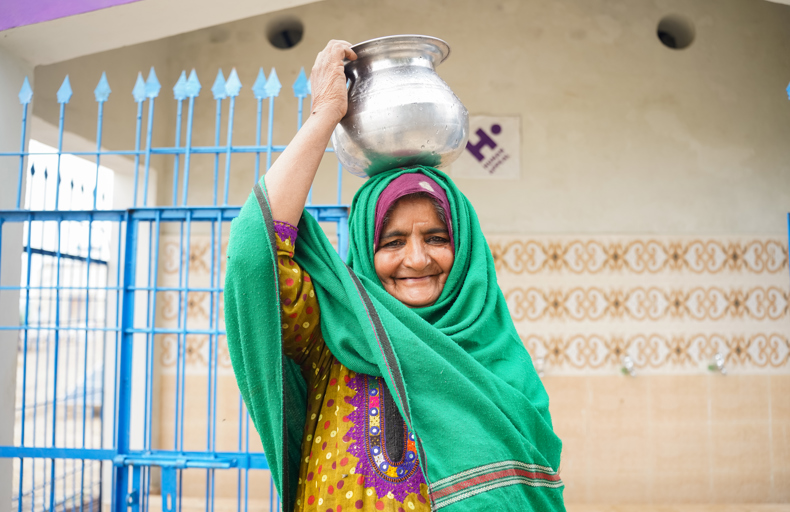
Five times a day, Muslims stand for prayer. Before each prayer, they perform wudu — a ritual washing of the hands, face, arms, and feet that Islamic law prescribes as the standard means of purification before salah. Water is not merely helpful here. It is the default, the norm, the means the faith was built around.
Islamic law does make provision for when water is unavailable. Tayammum — dry ablution using clean earth, sand, or stone — is explicitly permitted by the Quran in Surah Al-Maʼidah (5:6) and Surah An-Nisaʼ (4:43) as a dispensation for genuine necessity: when water genuinely cannot be reached, when using it would cause harm, or when it is too scarce to spare. This is a mercy built into Islamic law, not a loophole.
But the very existence of tayammum as a legislated exception reveals something important. The faith had to create an alternative for extreme circumstances — which means water access is foundational to Islamic worship in ordinary life. A community living without clean water is not just facing a public health crisis. It is living inside the exceptional case that tayammum was designed to address. Islam provided for this situation. But “provided for” is not the same as “intended this.”
What the Quran Says About Water and Purification
Surah Al-Maʼidah (5:6) addresses both forms of purification together, in a single verse: wudu with water is established as the standard; tayammum with clean earth is permitted for those who “do not find water.” That hierarchy is explicit. Water first; earth only when water is genuinely absent.
The Prophet (PBUH) said: “Cleanliness is half of faith.” (Sahih Muslim, 223). Taharah — ritual purity — is described across the Sunnah as a defining quality of the believer. In the normal circumstances of Islamic life, it is built around water.
The Scale of the Problem
According to the WHO and UNICEF, 2 billion people globally lack access to safe drinking water at home. In Gaza, around 97% of groundwater is contaminated. In Yemen, more than 18 million people lack reliable access to safe water. In parts of Pakistan, Somalia, and sub-Saharan Africa, the situation is no different.
For Muslim families in these regions, the water crisis forces a daily encounter with the exceptional case. Families resort to tayammum not by choice but by necessity — because the water that Islamic worship was built around is not accessible. What the Quran treats as a concession for extreme circumstances has become the daily norm for millions. That is the measure of the crisis.
Why Giving Water Is a Deeply Islamic Act
The Prophet (PBUH) was once asked: “Which charity is best?” He replied: “Providing water.” (Sunan Abi Dawud, 1681). The hadith connects the act of giving water directly to the highest form of voluntary charity — not because water is practical, but because it enables life, dignity, and worship all at once.
When you fund a well or a water system in a community that lacks one, you are not simply solving a thirst problem. You are enabling the five daily prayers of every person who draws from that source. Every wudu performed, every ghusl completed, every ablution before Jumu‘ah — the reward, in the Islamic tradition, continues to flow back to you.
Water for Mosques
In many of the regions where Human Appeal works, mosques serve as the centre of community life — for prayer, for education, for gathering. A mosque without reliable clean water cannot serve its community properly. Installing clean water access at a mosque serves not just one household but an entire congregation, day after day, prayer after prayer.
The Islamic connection to water runs deeper than we often recognise in comfortable circumstances. To give water is to give prayer. To give prayer is to give dignity. The obligation of taharah makes water charity uniquely intertwined with the practice of Islam itself.
Sources
- Qur'an: Surah Al-Ma'un (5:6) — obligation of wudu before prayer
- Sahih Muslim, 223 — “Cleanliness is half of faith”
- Sunan Abi Dawud, 1681 — water as the best form of charity
- WHO / UNICEF Joint Monitoring Programme — 2 billion people without safe water
- UNICEF Gaza — 97% of groundwater unfit for consumption
- UN OCHA Yemen — 18 million without reliable safe water access
Quick Donate
Quick Donate
Type


